
Concrete Poured for Las Vegas Temperatures, Not National Averages
Retarding admixtures, timed pours, and curing blankets — standard on every summer project we complete.
Las Vegas Concrete Placement Requires a Different Mix Design Than Most U.S. Markets
When ambient temperatures exceed 90 degrees, standard concrete placement procedures stop working correctly.
Las Vegas crosses that threshold for five to six consecutive months a year. That’s not an occasional heat event — it’s the baseline operating condition for more than half the construction calendar. At 90 degrees and above, the American Concrete Institute’s ACI 305 standard for hot-weather concreting requires modified placement procedures.
Those modifications — adjusting the water-to-cement ratio, adding a retarding admixture to slow initial set, and applying a curing blanket or misting protocol immediately after placement — are emergency responses to unusual heat in most markets. In Las Vegas, they’re the standard procedure every time summer concrete goes down.

Above 90 Degrees, the Workability Window Closes Fast
For five to six months a year, Las Vegas pours happen above the temperature where standard procedures break down. Without a retarding admixture and an early-morning schedule, the surface starts to set before finishing is complete — which permanently compromises the top layer, even when the slab looks intact through the first season.
Why Summer Pours in Clark County Follow a Modified ACI 305 Protocol
Concrete placed without heat-adjusted procedures produces a weaker surface layer that fails within the first few temperature cycles.
The cracking isn’t always visible immediately. Concrete that loses moisture before the chemical hardening finishes looks intact through the first season — but doesn’t hold up through the second or third. And with Las Vegas swinging 40 to 50 degrees between summer highs and winter lows, expansion joints have to be spaced and cut at the correct depth for that specific thermal range — a moderate-climate joint pattern doesn’t transfer here.
The procedure is straightforward: schedule the pour for the coolest part of the day, use a retarding admixture above 90 degrees, and apply curing compound or a blanket immediately after finishing. All three are built into our placement process on every summer project.
The Sub-Base and Temperature Assessment We Complete Before Every Pour
Two things the mix design can’t compensate for: sub-base consistency and ambient temperature at the planned pour time.
I walk every site before a cubic yard of concrete is ordered. Before I write any pour scope, I check two things the mix can’t fix: sub-base consistency and the ambient temperature at the planned pour time.
The sub-base matters here more than in most markets. Las Vegas sits on caliche — a calcium-carbonate layer beneath the topsoil that’s non-uniform. It can be solid rock two feet down in one corner and fractured material in another corner of the same lot, and that inconsistency causes differential settlement: a slab over inconsistent support cracks where caliche transitions from solid to fractured, no matter how well the mix is designed.
Temperature assessment runs alongside it. I schedule pours on the forecast for that specific day, not the calendar — a late-September morning can still read 88 degrees at 6 a.m., so we check the window and move accordingly.
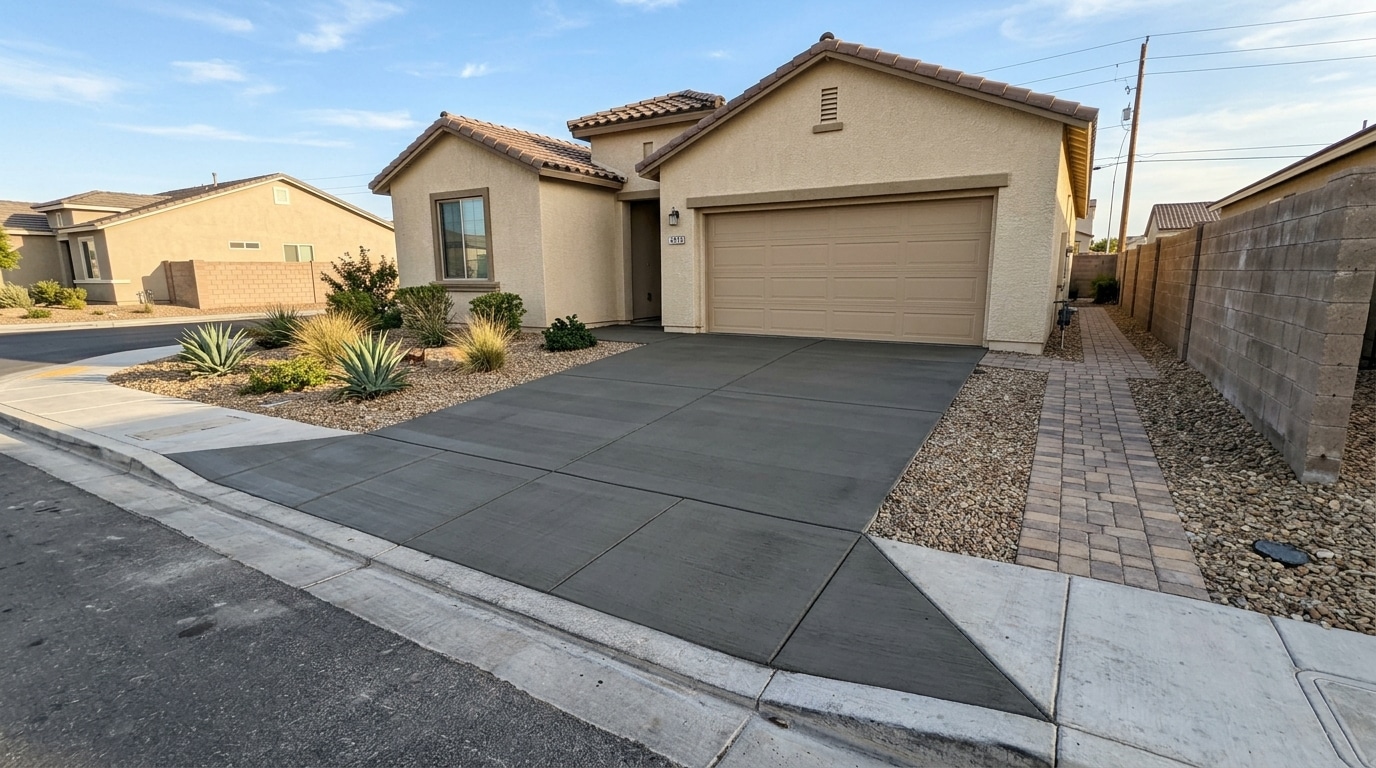
On a recent southwest-valley driveway, the site looked uniform from the surface. Excavating for sub-base prep, we found a caliche shelf that dropped off sharply along the left edge of the slab. We added compacted aggregate to level the support profile before any concrete went down. The homeowner didn’t see that work — they got a driveway that sits flat four years later.
Founder, 1 Home Construction LLC
A Slab Is Only as Flat as the Sub-Base Under It
Caliche transitions from solid rock to fractured material within a single lot, and a slab poured over that inconsistency cracks at the transition points. We excavate, confirm caliche depth, and bring the base to a consistent support profile — adding compacted aggregate where needed — before any concrete is ordered.

Mix Design, Retarding Admixtures, and Curing Blankets — On Every Project
Every pour uses a mix design and curing protocol matched to actual site conditions — not a premium option, our baseline.
Built Into Every Las Vegas Pour
- Water-to-cement ratio reviewed before every order, adjusted for ambient temperature and application
- Retarding admixture added when day-of ambient temperature exceeds 90 degrees
- Expansion joints formed or cut to a spacing and depth matched to Las Vegas's thermal range, not national tables
- Curing compound or blanket applied immediately after finishing to hold surface moisture
- Pour scheduled to the coolest available window, typically before 9 a.m. from June through September
For decorative concrete — stamped patterns, exposed aggregate, integral-color flatwork — we apply UV-stable sealers rated for desert exposure after full cure, because Las Vegas receives high annual solar radiation.
How We Schedule and Place Concrete Across All Application Types
Concrete scheduling in Las Vegas is a daily decision, not a calendar assumption — the same sequence runs regardless of application type.
Diagnostics
Sub-base is evaluated before the pour date is set, with caliche depth and consistency confirmed by excavation and base material compacted and leveled before any forming begins. The temperature forecast for the scheduled window is reviewed 48 hours out and again the morning of the pour.
Implementation
Mix design is ordered specific to that pour’s application, ambient conditions, and exposed surface area, with retarding admixtures added at the batch plant when temperatures warrant. Forms are set, reinforcement is placed, and the crew positions for continuous placement — no stopping mid-slab.
Post-Service Testing and Curing
Curing compound or a curing blanket goes down immediately after finishing. For slabs that carry vehicles or support a structure, we confirm cure time before any load is applied, cut or form expansion joints to the correct depth within the right timeframe, and complete a final surface inspection before any decorative sealer is applied.

Stamped Concrete Needs the Admixture to Buy Time
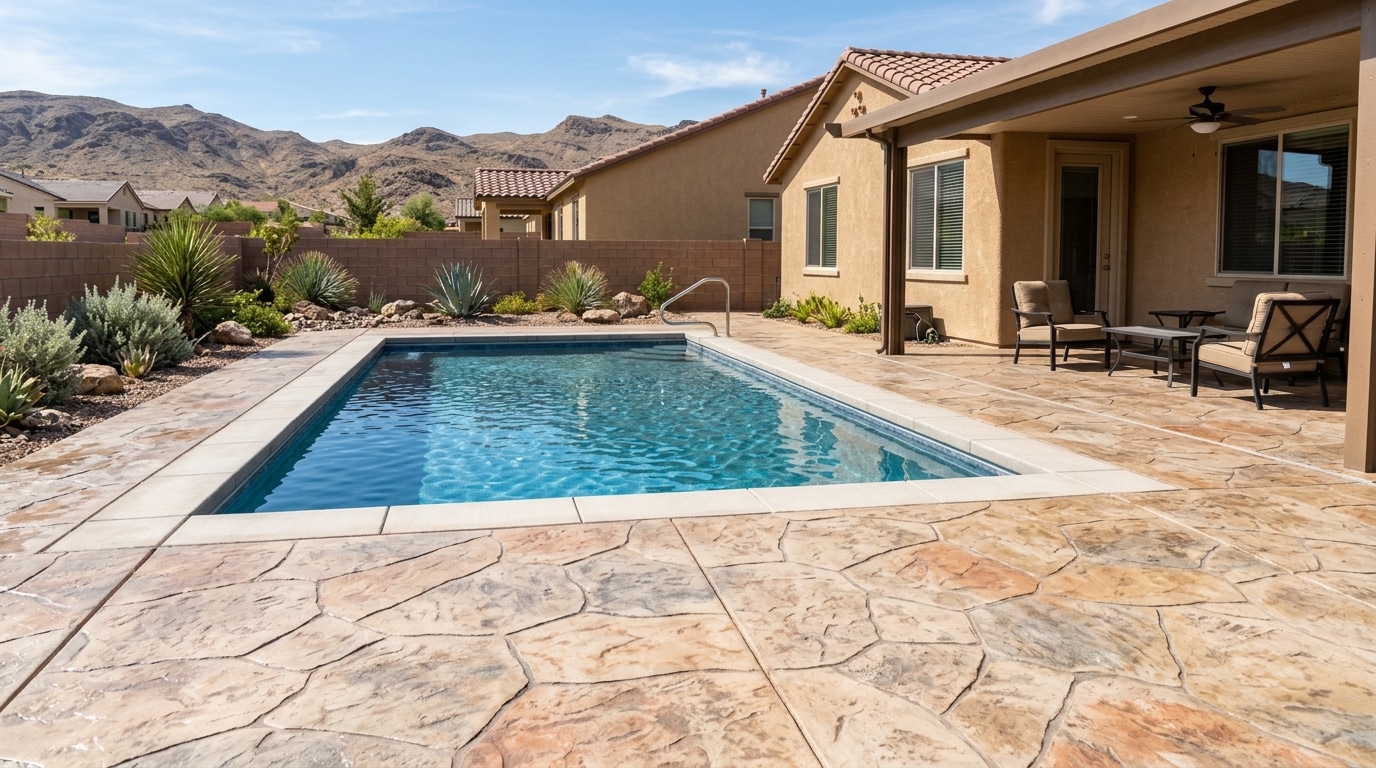
Decorative flatwork — stamped, exposed-aggregate, or integral-color — has to take its texture before the slab sets, and in summer heat that window closes fast. We add a retarding admixture as standard on every decorative pour from May through October and schedule it for the early-morning hours, then seal with UV-stable products after full cure.
Driveways, Slabs, Flatwork, and Retaining Walls
Each concrete application in Las Vegas has one variable that matters more than the others.
Concrete Driveways
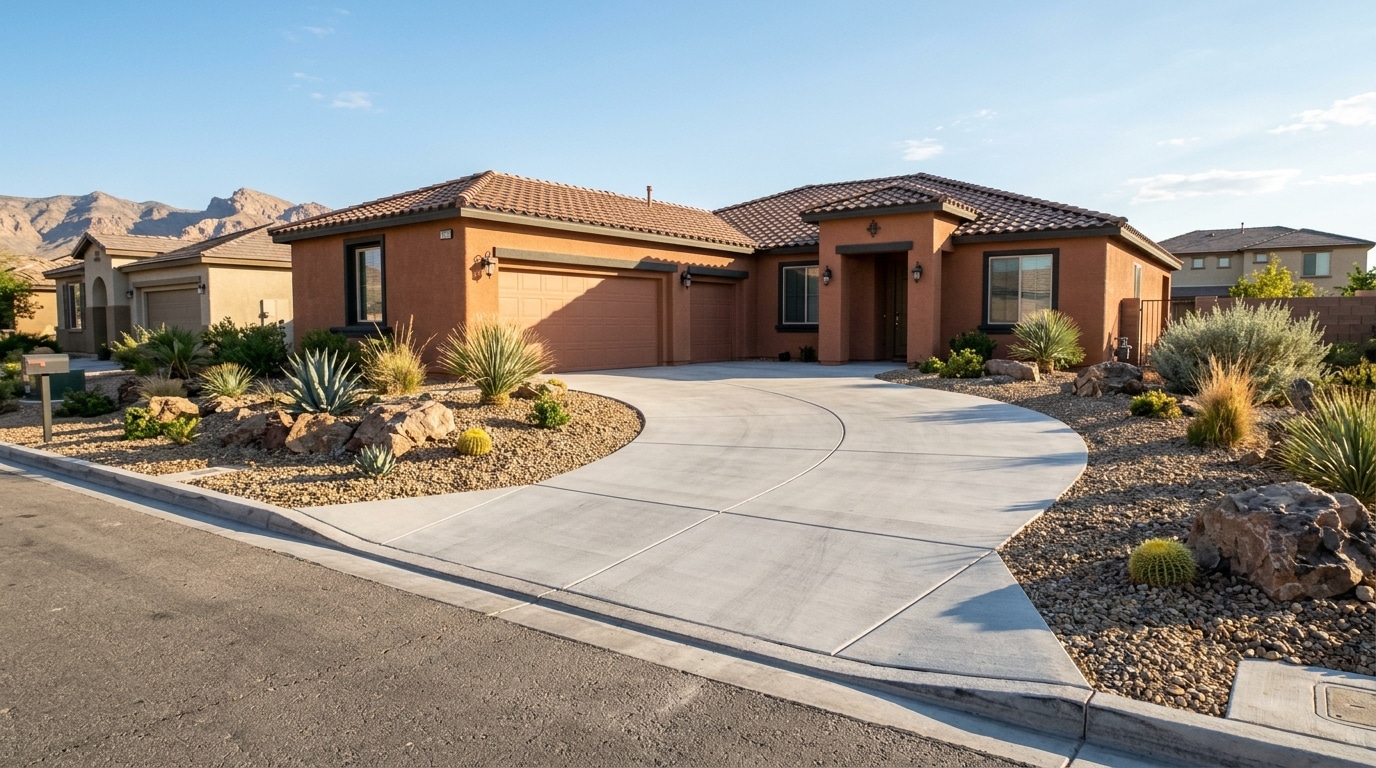
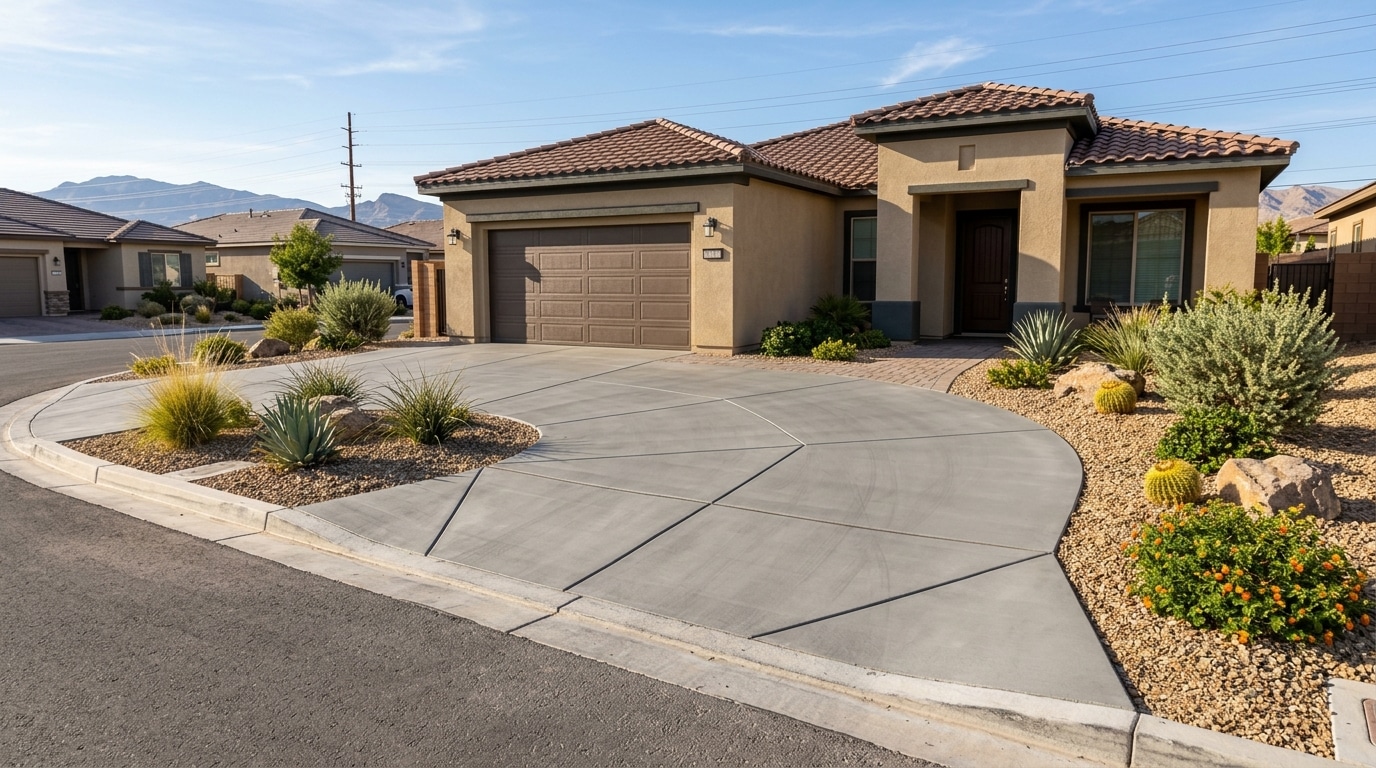
Surface durability under thermal cycling is the variable — direct sun all day, expansion in summer, contraction on winter nights. Joint placement at Clark County’s 40-to-50-degree range decides whether it stays intact or cracks.
Foundation & ADU Slabs
Structural slabs carry a higher sub-base standard. Caliche is assessed and brought to a consistent support profile before forming, and these slabs tie to a Clark County foundation inspection before framing.
Flatwork — Patios & Walkways
Stamped, exposed-aggregate, and integral-color finishes need the pattern applied before the slab sets — a window that closes fast without a retarding admixture. UV-stable sealers follow full cure.
Concrete Retaining Walls
Walls over four feet (measured from the footing bottom) require a Clark County permit and structural-engineer review, which we pull as contractor of record. Footing depth accounts for caliche variability so the wall doesn’t move unevenly.
Concrete Work Across Clark County
1 Home Construction places concrete on residential and ADU projects throughout Clark County, Nevada.
Our work covers Henderson, Summerlin, the southwest valley, North Las Vegas, and surrounding communities — driveways, structural slabs, decorative flatwork, and retaining walls, all under License #0090486 with in-house crews who’ve worked Las Vegas conditions since 2004.
Explore related projects: deck construction, covered patios, custom outdoor patio spaces, and pool construction.
Start Your Las Vegas Concrete Project on the Right Foundation
Concrete placed correctly in Las Vegas starts with sub-base assessment and mix design — not a price-per-yard quote. Describe your project and we’ll schedule a site visit, assess your sub-base, and give you a scope built for Clark County’s climate before a single yard is ordered.
Email office@1homeconstruction.com · 5875 S Rainbow Blvd #204, Las Vegas, NV 89118 · License #0090486
Concrete Installation Questions From Las Vegas Homeowners
Ambient temperatures above 90 degrees shorten the workability window significantly. We schedule pours before 9 a.m. from June through September and add a retarding admixture to extend the working time. Without that adjustment, the surface can begin to set before finishing is complete, which permanently compromises the top layer.
Caliche is a calcium-carbonate layer found beneath the topsoil throughout Clark County. It’s non-uniform — solid in some areas, fractured in others, even within the same lot — and a slab poured over inconsistent caliche settles unevenly and cracks at the transition points. We excavate and assess caliche depth and consistency before any forming begins.
Yes. Retaining walls over four feet in height, measured from the bottom of the footing, require a Clark County building permit and structural-engineer review. We pull the permit as the licensed contractor of record under General Construction License #0090486.
A retarding admixture is a chemical additive mixed into the concrete at the batch plant that slows the initial set time, preserving workability in high heat. We add it as standard practice when ambient temperatures exceed 90 degrees, and there’s no separate line-item charge — it’s built into our placement process.
Las Vegas experiences temperature swings of 40 to 50 degrees between summer highs and winter lows, so expansion joints have to be spaced and cut at a depth that accommodates that full thermal range. Joint-spacing tables designed for moderate climates underestimate the movement here, so we size joints specifically for Clark County’s conditions, not national defaults.
Yes, with the correct admixture and scheduling. Stamped and textured concrete requires the pattern to be applied before the slab sets — a window that closes quickly in summer heat. We use retarding admixtures on all decorative flatwork placed between May and October and schedule those pours in the early-morning hours to protect that finishing window.